
January 2nd, 2026 - Order from JCM-1 🇺🇸, ToTs Retro 🇺🇸, Amiga of Rochester 🇺🇸, or Flamelily Retro 🇬🇧
Join the conversation on TinkerDifferent.com, BlueSky, Mastodon, Discord.
We're starting the year with a bang! Today we're announcing two new versions of BlueSCSI: Ultra and Ultra Wide. These new models support faster Ultra SCSI connections to better support more high-end workstations and SCSI cards. These are more than iterative updates and continue our 100% original hardware designs as well as GPL firmware.
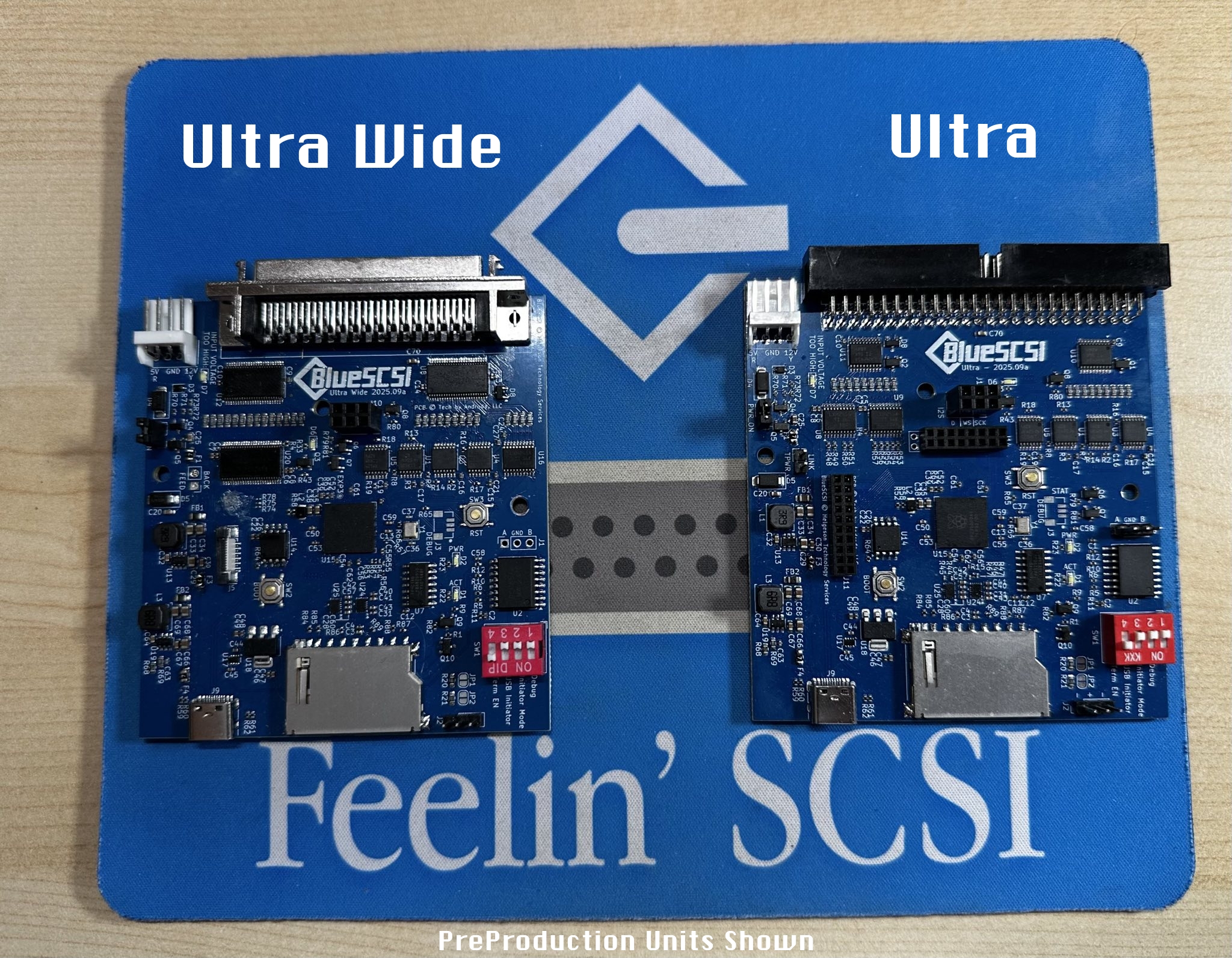
BlueSCSI Ultra and Ultra Wide are next-generation, open-source SCSI emulators designed for higher-end vintage systems, delivering faster SD card performance, new audio capabilities, and expanded hardware features while preserving BlueSCSI's simplicity and ease of use. Ultra supports 50-pin Narrow SCSI, while Ultra Wide adds 68-pin Wide (and upcoming SCA) support for workstations and servers from the early-to-mid 1990s. Both models feature an integrated RP2350B, USB-C, 16 MB of flash, I²S CD audio (via an optional audio board), web-based configuration via front-panel integration, enhanced power protection, and significantly faster SD transfers through dynamic voltage switching. These are not incremental updates, but a major evolution of BlueSCSI's original hardware platform—continuing its GPL firmware tradition and commitment to open, user-friendly design.
TL;DR: What's New
- 68-pin Ultra Wide(16-bit) SCSI support (SCA models very soon as well)
- 50-pin Ultra(8-bit) SCSI support
- Integrated RP2350B (No Pico)
- Front Panel support with Web interface (same as PicoIDE)
- CD Audio Support
- New faster SD architecture
- 16MB flash
- USB-C
- GPIO expansion ports for future upgrades
- Physical switches for Debug/Initiator/USB/Termination
- PCB mounting holes have stayed the same
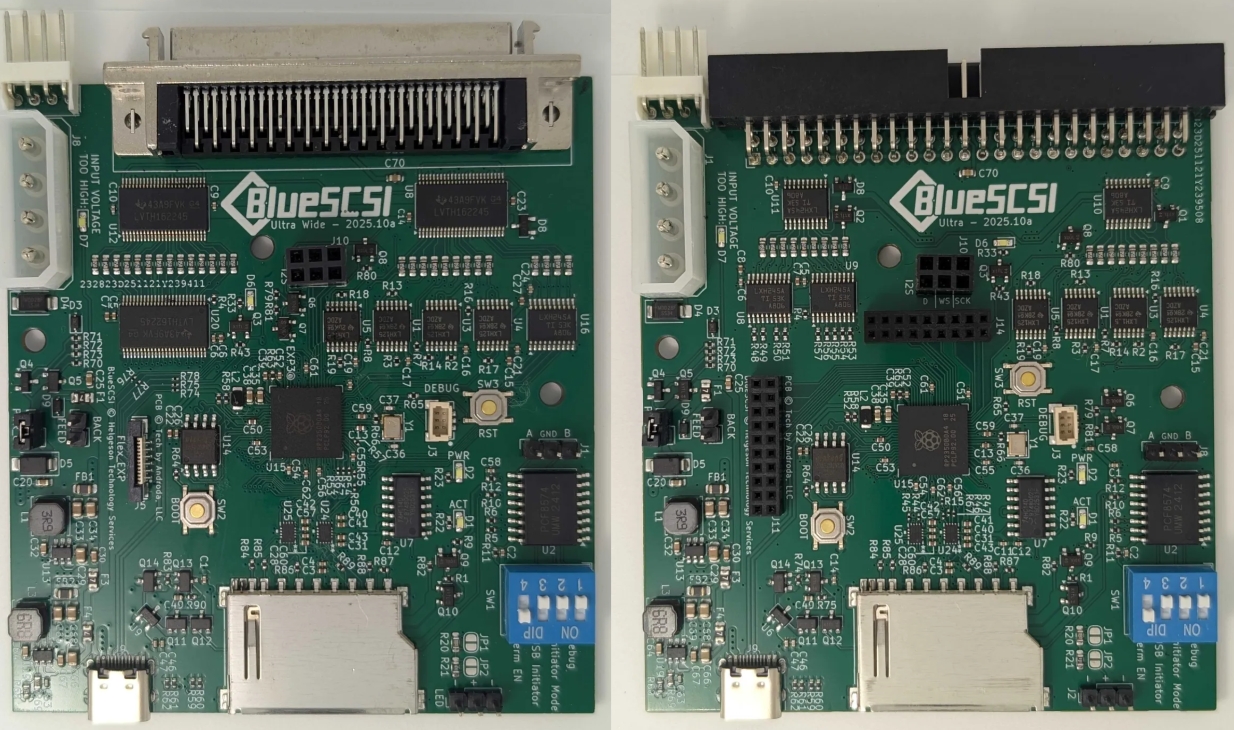
BlueSCSI Ultra Wide
We've merged in the Wide support from ZuluSCSI Wide (yay GPL!) as a base and improved it from there, integrating it into our original hardware design and using the BlueSCSI philosophy of simplicity and ease of use.
Adding Wide capabilities enhances our BlueSCSI support for the early-to-mid 1990s for workstations, servers, and other high-end SCSI devices of the era. Supporting 68-pin connectors... and soon SCA.
Use the BlueSCSI ecosystem you love in your Mac Plus all the way up to your '90s Sun workstation.
BlueSCSI Ultra
BlueSCSI Ultra offers all the features of the Ultra Wide model with a 50-pin connector: SPI front panel support, faster SD card access, I2S CD audio support, additional flash storage, power protections, integrated RP2350B, and more!
Front Panel
We've partnered with Ian Scott (of PicoGUS) to support their intuitive front panel display. Ian is launching a fully open source emulator PicoIDE to use the same 3.5" case with an interactive front panel for changing CDs, settings, etc. It also runs a web interface you can use from your desktop or phone to configure the device on-the-fly. Heck you can even upload files to the SD card as well!
Don't worry, we haven't left out the existing BlueSCSI owners. This Front Panel will also work with your existing BlueSCSI v2 models over I2C.
SD Card Improvements
BlueSCSI Ultra and Ultra Wide use a new transceiver-based SD card communication system, which follows the SD spec more closely than ever before. The publicly-available SD spec shows clock speeds of up to 50 MHz at 3.3 V which is good for up to about 25 MB/sec transfer speeds. This is clearly not enough for Wide SCSI-2's max of 40 MB/sec (theoretical - many systems never reach this speed).
Thanks to a publicly-released application note from a vendor describing the voltage switch sequence, BlueSCSI Ultra and Ultra Wide will now dynamically switch to 1.8 V and drive the SD clock up to 83 MHz (depending on the individual SD card). This eliminates most of the SD communication speed bottleneck. The SD card itself now plays a large role in read and write speeds, with any card variation showing immediately because the max possible speed is so much higher.
Audio Support
BlueSCSI Ultra and Ultra Wide both support I2S audio output for CD audio emulation. To get that audio out of the board, you'll need an add-on BlueSCSI Ultra Audio Board, which works with both models and gives you three output options:
- Vintage Apple CD-ROM connector
- Standard PC CD/DVD audio header
- 3.5mm headphone jack
Power Options
BlueSCSI Ultra and Ultra Wide won't be able to be powered via the bus like BlueSCSI v2. We've included both a berg and molex power connector options on the board for flexibility.
Additional power protections have been added in - if your vintage system's PSU goes above 5.6 V the BlueSCSI Ultra will power itself off to protect from overvoltage.
Ultra Expander
The Ultra Expander is an optional expansion board for BlueSCSI Ultra (50-pin) that adds WiFi support and the SPI flex cable connector for supporting the Front Panel board.
Ultra Wide (68-pin) has the SPI port built-in, so it doesn't need the Expander - just connect the Front Panel directly via flex cable.
Quick Feature Comparison
| UW/SCA | Ultra | v2 | |
|---|---|---|---|
| Audio | ✅ | ✅ | ✅ (SPDIF) |
| Front Panel | ✅ | ✅ | ✅ (I2C) |
| DaynaPORT (SCSI Networking) | ❌ | ✅ | ✅ |
| Extra GPIO | ✅ | ✅ | ❌ |
| Flash | 16MB | 16MB | 2MB |
| Chip | RP2350B | RP2350B | Pico1/2 |
| Powered by Bus | ❌ | ❌ | ✅ |
Cost
We want to keep BlueSCSI as affordable as possible. Tariffs and the cost of goods are making that harder, but we've managed to keep BlueSCSI v2 under $50 USD in most regions for most resellers.
The good news is we're keeping the prices as low as possible:
- Ultra 50-pin - $59
- Ultra Wide - $75
- Ultra SCA - $85 (most of the extra cost is the SCA connector!)
We hope you're as excited as we are about this next evolution of BlueSCSI! EVT evaluation boards have been sent out for review. We're continuing the tradition of building an easy to use, customer-focused line of products. No license keys, closed FPGAs and/or other DRM nonsense is used in our open source solutions. 2026 is going to be a great year for BlueSCSI!
Thank you to Androda, Jokker, Polpo, and Gutbomb for their contributions to BlueSCSI Ultra!
FAQ
Q: How fast is it!?
A: When going this fast, quality SD cards, cabling, and termination play a huge factor. We've been able to reach over 30 MB/sec read and 15 MB/sec write with the limited hardware we've tested on and expect other systems to go even closer to the 40 MB/sec mark.
Q: What connectors will Ultra support?
A: SCA (soon), 68-pin Wide SCSI, 50-pin Narrow SCSI. There are currently no plans for DB25 or other connectors in the Ultra line.
Q: Why can't BlueSCSI Ultra and Ultra Wide run from SCSI termination power?
A: During internal testing, it was discovered that some older computers couldn't complete a benchmark run on Ultra when running only from Termpower. This turned out to be a Termpower issue: the voltage was unstable with the notably higher current draw that Ultra needs to maintain the higher SD transfer speeds. The decision to require use of berg/molex power is for system stability. BlueSCSI v2 already draws a fair bit of power and Ultra needs even more.
Q: Should I upgrade from my BlueSCSI v2 to Ultra/Ultra Wide?
A: We're still actively developing and maintaining BlueSCSI v2 - adding SPDIF audio support and it can use the same front panel. If you need Wide/SCA support, faster SD speeds, or I2S audio output, then yes, upgrade! If not, continue to enjoy your BlueSCSI v2!
Q: Does this fix the GPIO constraints for AS/400, CISC 9404-F10, and VAXstation 2000?
A: Yes! With the additional GPIO pins on the RP2350B, we can now support those three systems that previously had compatibility issues.
A Note on Hardware Licensing
BlueSCSI firmware remains GPL, same as always. For the Ultra hardware designs, we're taking a phased approach: initial release will be closed-source to help us recoup development costs, then moving to a fully libre license. We're committed to open hardware - we just need to get there sustainably.